
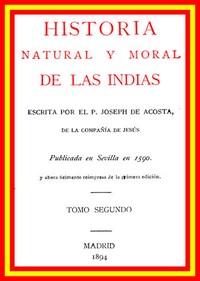
Historia natural y moral de las Indias (vol. 2 of 2) by José de Acosta
José de Acosta's Historia natural y moral de las Indias isn't a novel with a plot, but it has one of the best stories you'll ever read: the story of a mind being blown, repeatedly, over 500 pages. Written in the late 16th century, it's Acosta's massive report on the Americas after living there for nearly two decades.
The Story
Think of it as a two-part investigation. First, the 'Natural History' is Acosta playing scientist. He describes the geography, plants, and animals with the awe of someone seeing them for the first time. How do you explain a hummingbird to someone who's never seen one? He tries. He puzzles over earthquakes and mines for silver. The second part, the 'Moral History,' is where he turns anthropologist. He documents the customs, governments, religions, and history of the Aztec and Inca empires with startling detail. The 'story' is his relentless quest to gather facts, compare them to European and Classical knowledge, and somehow stitch it all into a coherent picture of God's creation.
Why You Should Read It
You read this not for final answers, but for the thrilling friction of the search. Acosta is a man of his time—a Jesuit missionary—but his intellectual honesty often shines through. When he argues that Indigenous peoples are fully rational and their civilizations impressive, he's pushing against racist ideas of his era. His famous theory about how humans first migrated to the Americas (suggesting a land bridge from Asia) shows a mind willing to follow evidence. You feel his genuine curiosity battling his preconceptions on every page. It’s this raw, unfiltered collision of two worlds that makes it so compelling. You're witnessing the birth of modern ethnography and natural science, complete with all its growing pains.
Final Verdict
Perfect for history buffs who want to go beyond dates and battles to the ideas that changed the world. If you enjoyed books like Guns, Germs, and Steel for their big-picture thinking, you'll appreciate seeing those questions asked in real-time, 400 years ago. It's also great for anyone fascinated by early science, exploration, or just incredible true stories. Fair warning: it's a dense, old text, so a good modern edition with notes is key. But if you stick with it, you get a front-row seat to one of history's greatest intellectual adventures.
This book is widely considered to be in the public domain. Preserving history for future generations.
William Thompson
2 months agoFast paced, good book.
Deborah Hernandez
1 year agoSurprisingly enough, the pacing is just right, keeping you engaged. Absolutely essential reading.