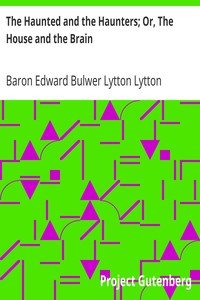
The Haunted and the Haunters; Or, The House and the Brain by Lytton
Let's talk about one of the great-granddaddies of the haunted house story. Before Hill House or the Overlook Hotel, there was a certain unassuming London townhouse in Edward Bulwer-Lytton's 1859 tale. This isn't your typical ghost story; it's a methodical investigation into the impossible.
The Story
The narrator is a man of science and reason, the kind of person who laughs at superstition. When he hears about a house so terrifying it has driven away every tenant, he sees it as the perfect challenge. He rents the place for a night, bringing only his servant and his unwavering belief in rational explanations. What starts as a curiosity quickly turns into a nightmare. Doors lock and unlock on their own. Strange, heavy footsteps pace empty rooms. Ghostly figures appear, not as clichéd specters, but as terrifyingly solid, lifelike forms. The haunting feels less like random poltergeist activity and more like a calculated attack. The climax isn't a battle with a monster, but a desperate attempt to understand the source of the evil—a force the story links to a powerful, corrupted will that has imprinted itself on the very structure of the building.
Why You Should Read It
What I love about this story is how smart it is. Bulwer-Lytton wasn't just trying to give you goosebumps (though he certainly does). He was playing with big ideas about the power of the mind, the nature of evil, and whether some places can absorb trauma and become poisonous. The narrator is a fantastic guide because we share his skepticism at first. As his confidence crumbles, so does ours. The horror works because it feels earned and logical, even when it's supernatural. The atmosphere is thick enough to cut with a knife, built through small, unsettling details rather than loud shocks.
Final Verdict
This book is perfect for readers who love a thinking person's horror. If you're a fan of Shirley Jackson, Henry James's The Turn of the Screw, or modern authors like Paul Tremblay who make you question what's real, you'll find a kindred spirit in this Victorian classic. It's also a great, quick read for anyone who wants to see where so many of our modern haunted house tropes began. Just maybe don't read it right before bed in a creaky old house.
This masterpiece is free from copyright limitations. You do not need permission to reproduce this work.
James Martinez
6 months agoIf you're tired of surface-level information, the quality of the diagrams and illustrations (if applicable) is top-notch. I appreciate the effort that went into this curation.
Mary Jackson
7 months agoAs a professional in this niche, the way the author breaks down the core concepts is remarkably clear. This exceeded my expectations in almost every way.
Patricia White
1 year agoI was particularly interested in the case studies mentioned here, the quality of the diagrams and illustrations (if applicable) is top-notch. I'm glad I chose this over the other alternatives.
Margaret Harris
9 months agoThis is an essential addition to any academic digital library.
George Rodriguez
1 year agoThe information is current and very relevant to today's needs.