
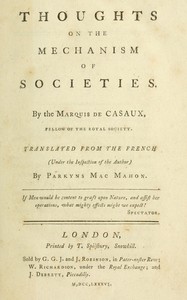
Thoughts on the mechanism of societies by marquis de Charles Casaux
Published in the powder-keg atmosphere of the late 18th century, Charles Casaux's Thoughts on the Mechanism of Societies is exactly what the title promises: a deep, systematic look at how human societies function. Forget a simple history book or a political rant. Casaux approaches society like a complex machine or a living organism. He wants to identify its core components—things like laws, commerce, agriculture, and social classes—and understand how they fit together and interact to create either prosperity or collapse.
The Story
There isn't a plot in the traditional sense, but there is a powerful narrative drive. Casaux is on a quest. He methodically breaks down the 'engine' of a nation. He looks at the role of government not as a divine right, but as a practical tool for maintaining order and facilitating growth. He examines property, trade, and population, seeing them as interconnected gears. A big part of his 'story' is arguing against what he saw as the simplistic, utopian ideas of some Enlightenment thinkers. He believed societies couldn't be rebuilt from pure theory alone; you had to understand the messy, practical mechanics already in place. The book is his attempt to provide that blueprint for understanding, written for an audience living through the ultimate test of those mechanics.
Why You Should Read It
I'll be honest, this isn't a breezy beach read. But the payoff is huge. Reading Casaux is like getting inside the head of a brilliant, pragmatic thinker at the most pivotal moment in modern history. You see the birth of modern political economy and sociology happening in real time. His focus on systems—how agriculture feeds industry, how laws shape commerce—feels incredibly relevant today. It strips away the drama of kings and battles and shows you the underlying structures that truly determine a society's fate. It makes you look at our own world differently, questioning what gears are turning in the background.
Final Verdict
This book is perfect for history buffs who want to go beyond dates and events to grasp the ideas that shaped the modern world. It's also great for anyone interested in political science, economics, or sociology who wants to see where those fields really began. If you enjoyed the big ideas in works by Adam Smith or Montesquieu but want to explore a less-known contemporary voice, Casaux is your guy. Come for the historical curiosity, stay for the surprisingly durable framework on how societies work. Just bring your thinking cap.
There are no legal restrictions on this material. Knowledge should be free and accessible.





Donald Garcia
4 months agoThe balance between academic rigor and readability is perfect.