
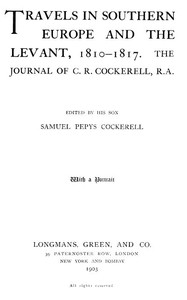
Travels in Southern Europe and the Levant, 1810-1817 by C. R. Cockerell
Forget everything you think you know about stuffy 19th-century travel writing. Travels in Southern Europe and the Levant reads like a real-life adventure novel. The 'plot' is simple: a young architect named Charles Cockerell leaves England for a multi-year study trip across Greece, Turkey, and the Middle East. But his plans immediately collide with the messy reality of a world at war and a culture completely foreign to him.
The Story
Cockerell's journey is one long, fascinating obstacle course. He wants to measure the Parthenon, but Athens is under Ottoman control. He dreams of visiting ancient sites in Asia Minor, but he has to navigate unpredictable local pashas and bandits. The central thread of his narrative becomes his involvement in the discovery and removal of famous sculptures from the Temple of Aphaia on Aegina and the Temple of Apollo at Bassae. This isn't a clean academic mission; it's a tense operation involving secret deals, rival collectors, and the constant threat of having his treasures confiscated. The book is his diary of these years—a mix of architectural notes, cultural observations, and genuine peril.
Why You Should Read It
What makes this book special is Cockerell's voice. He's not a distant, perfect hero. He's often frustrated, frequently amazed, and sometimes in over his head. You feel his awe when he first sees a monumental ruin, and his anxiety when a deal goes sideways. He doesn't judge the places he visits from a high horse; he tries to understand them. Through his eyes, you get a ground-level view of history happening. You see the day-to-day life in the Ottoman Empire, the fading glory of Venice, and the raw beauty of landscapes few Europeans had ever described. It’s history without the filter.
Final Verdict
This book is perfect for anyone who loves real adventure stories, armchair travel, or history that feels immediate and human. If you enjoyed The Lost City of Z or Patrick Leigh Fermor's walking tours, you'll find a kindred spirit in Cockerell. It's also a great pick for architecture fans who want to know the wild stories behind how ancient masterpieces made it to museums. Fair warning: it's a product of its time, so some attitudes will feel dated. But read it for the incredible journey of a curious man thrown into the deep end of the ancient world. You'll feel like you're right there with him, dust on your boots, wondering what's around the next corner.
This content is free to share and distribute. Knowledge should be free and accessible.
Kimberly White
7 months agoBefore I started my latest project, I read this and it manages to maintain a consistent flow even when discussing difficult topics. An excellent example of how quality digital books should be formatted.
Robert Lopez
4 months agoFrom a researcher's perspective, the way it handles controversial points with balance is quite professional. Truly a masterpiece of digital educational material.
Richard Walker
7 months agoAs someone who reads a lot, it provides a comprehensive overview perfect for everyone. Thanks for sharing this review.
Carol Jones
11 months agoAfter hearing about this author multiple times, the storytelling feels authentic and emotionally grounded. Truly inspiring.





Susan Jackson
2 months agoAs a professional in this niche, the insights into future trends are particularly thought-provoking. I am looking forward to the author's next publication.