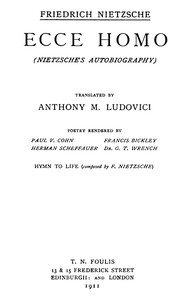
Ecce Homo by Friedrich Wilhelm Nietzsche
Friedrich Nietzsche’s Ecce Homo isn't a story in the traditional sense. It's an autobiography, but calling it that feels too small. Written in a frantic few weeks near the end of 1888, it’s Nietzsche’s attempt to explain himself—to the world, and perhaps to himself.
The Story
The book is structured around strange, boastful chapter titles like 'Why I Am So Wise' and 'Why I Write Such Good Books.' Nietzsche walks us through his life, his diet (he was very serious about his food), his health struggles, and his climate preferences. But the real heart of it is his guided tour of his own philosophy. He takes his major works—Thus Spoke Zarathustra, Beyond Good and Evil—and breaks down what he was trying to do, often with a mix of pride and frustration that the world hasn't caught up yet. There's no plot twist, but the dramatic tension comes from knowing this is his last coherent work. The 'story' is the spectacle of a genius standing at the edge, pointing back at everything he built.
Why You Should Read It
You should read this because it’s human. After wrestling with heavy concepts in his other books, here you get Nietzsche the person. His voice is startlingly direct. He’s funny, petty, painfully honest about his migraines, and utterly convinced of his own historic importance. It makes his ideas feel less like abstract theories and more like the products of a specific, struggling, brilliant life. Reading it, you see the roots of his philosophy in his daily experiences. It also reframes his earlier work. His rant about why Zarathustra is the greatest gift to humanity is half madness, half stunning literary criticism. It’s a messy, intimate backstage pass to one of history's most influential minds.
Final Verdict
This book is perfect for anyone curious about Nietzsche but intimidated by his heavier works. It's a surprisingly accessible and personal entry point. It's also a must-read for fans who know his philosophy but want to meet the man behind it. Ecce Homo is not a balanced, careful memoir. It's a raw, eccentric, and unforgettable self-portrait. Be prepared to be fascinated, confused, and maybe a little concerned for the author. You won't read anything else like it.
Legal analysis indicates this work is in the public domain. Distribute this work to help spread literacy.
Mary Thompson
1 month agoThe layout of the digital version made it easy to start immediately, the quality of the diagrams and illustrations (if applicable) is top-notch. It definitely lives up to the reputation of the publisher.
Linda Jackson
1 year agoAs someone working in this industry, I found the insights very accurate.
Margaret Harris
1 year agoI took detailed notes while reading through the chapters and the argument presented in the middle section is particularly compelling. Highly recommended for those seeking credible information.
Thomas Taylor
10 months agoAs a professional in this niche, the chapter on advanced strategies offers insights I haven't seen elsewhere. Highly recommended for those seeking credible information.
Susan Taylor
2 months agoI wanted to compare this perspective with traditional views, the critical analysis of current industry standards is very timely. A mandatory read for anyone in this industry.