About 321 minutes
The New Girl at St. Chad's: A Story of School Life — Edition Insights
Fantasy Juvenile Worlds
73,639 recorded words. 11 minutes difference from this book's estimate.
View Gutenberg source #24025
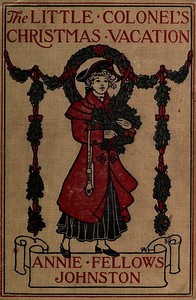
Before opening The Little Colonel's Christmas Vacation — Story, Setting & Ideas, the edition data offers a quick orientation: 76,299 words, 5 hr 32 min estimated reading time, and 8 detected text sections.
The text analysis averages about 16.3 words per sentence, while the detected sections provide another way to judge how the source is divided.
Project Gutenberg metadata also associates the work with “Boarding schools -- Juvenile fiction,” connecting these edition facts with the source record’s subject description.
Explore this collection
These alternatives are selected using recorded categories and estimated reading time.
About 321 minutes
Fantasy Juvenile Worlds
73,639 recorded words. 11 minutes difference from this book's estimate.
View Gutenberg source #24025About 321 minutes
Fantasy Juvenile Worlds
73,645 recorded words. 11 minutes difference from this book's estimate.
View Gutenberg source #25334About 308 minutes
Fantasy Juvenile Worlds
70,718 recorded words. 24 minutes difference from this book's estimate.
View Gutenberg source #31387Search stored excerpts and compare books → Choose by your preferences →
Choices use stored catalog measurements. Estimates vary with reading speed. A shared category is a catalog label, not a claim that two books have the same argument or literary quality.
Search reads excerpt text stored with this catalog and links to its associated Gutenberg record. The connection is stored in the site database; this tool does not recheck that every excerpt is word-for-word identical to that external record. Excerpt search does not cover every chapter and does not verify historical publication dates.
Catalog snapshot checked: 2026-09-26. Coverage: 99 public books, 99 available source excerpts.
Calculated from edition completeness, EPUB availability, text structure and catalogue metadata. Not a user rating.
Total of 100 points, scaled to a 2.5-5.0 range. Editions with an empty description or a missing EPUB file are not scored.
Public-domain source text
The source text is kept in the dedicated reader, separate from this catalogue record and its commentary.
The narrative opens with Lloyd Sherman, home from Warwick Hall for the holidays, delighting in a diamond ring that once belonged to her grandmother Amanthis. The ring becomes a tangible link between past and present, as Lloyd imagines it holds "the joy of three Christmas days." This object, along with the family harp and an old cloisonné rose-jar, anchors the story in material heirlooms that carry emotional weight.
The excerpt reveals a household bustling with preparations for a progressive Christmas party, where guests move from house to house. Lloyd explains the game to her grandfather: each guest receives a rhyming clue leading to a hidden gift. The party structure—a Christmas hunt, dinner at Oaklea, and evening at The Beeches—shapes the plot around communal celebration rather than individual conflict.
The diamond ring that Lloyd receives is not merely a gift; it is a narrative device that connects three generations. Lloyd addresses the portrait of Amanthis, saying, "when you played on the harp, it flashed on yoah hand just as it does on mine." This direct address to the past, rendered in Lloyd's distinctive Southern dialect, suggests a continuity of experience. The ring's "flashing heart" is described as holding "a triple happiness," linking Lloyd's Christmas, her mother's, and Amanthis's. The harp, too, is a recurring prop: Lloyd plays an old song for her grandfather, knowing it "helped to bring back his happy past." These objects function as emotional conduits, allowing the story to layer present joy with remembered joy without explicit flashbacks.
The Christmas party is not a single event but a sequence: a hunt at Lloyd's home, dinner at Oaklea, and evening festivities at The Beeches. This structure, described in detail by Lloyd, drives the narrative forward. The hunt involves rhyming clues—for example, "Seek where bygone summers / Have dropped their roses fair"—which lead to hidden packages. The game requires participants to remember the household's history, such as the rose-jar that "Grandmothah Amanthis" kept filled. The party thus becomes a vehicle for exploring the house and its memories. The excerpt shows Lloyd explaining the plan to her grandfather, who admits he "hasn't been able to gather a very good idea of what's expected." This moment of gentle humor highlights the contrast between the younger generation's elaborate social schemes and the older generation's simpler expectations.
Lloyd's speech is marked by a consistent Southern dialect: "mothah," "fathah," "yoah," "neahly," "ovah." This voice is not merely decorative; it establishes her character as rooted in a specific place and class. Her language contrasts with the more standard narration, creating a distinct aural texture. The domestic details are precise: the "rare old cloisonné rose-jar," the "Christmas stocking trimmed with holly and hung with tiny sleigh-bells," and the "ripe cherry with a bee clinging to its side" that conceals a gift. These items are described with a collector's eye, suggesting a world where objects carry stories. The progressive party itself—moving from house to house—reflects a close-knit community of families (the Moores, Waltons, and Shermans) who share holiday traditions. The excerpt does not reveal conflicts or resolutions, but it establishes a setting where social rituals and inherited treasures define the Christmas experience.
Readers should attend to how the story balances multiple threads: the ring's symbolic weight, the party's logistical comedy, and the quiet moments between Lloyd and her grandfather. The excerpts offer no clear antagonist or central crisis, suggesting the novel may prioritize atmosphere and tradition over plot. Pay attention to how objects—the ring, the harp, the rose-jar—are used to bridge past and present, and how Lloyd's dialect marks her as both a modern schoolgirl and a keeper of family legacy.
That little Kentucky Christmas felt like holding a warm stone—traditions and that odd ring passing quietly through generations. It made me think of another trail, wilder and colder, where a boy walks alone with his own inheritance. There’s a similar hush in Deerfoot in The Mountains — Key Ideas to Explore, that sense of carrying something old inside you. I found myself still turning both over days later.
Answer a few questions and save a private reflection on this device.