About 602 minutes
St. Winifred's; or, The World of School — Edition Insights
Fantasy Juvenile Worlds
138,234 recorded words. 35 minutes difference from this book's estimate.
View Gutenberg source #24329
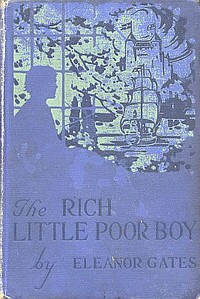
The Rich Little Poor Boy — Context and Discussion can be approached with a clearer sense of reading commitment from its source measurements: 130,294 words, 9 hr 27 min estimated reading time, and 13 detected text sections.
The text analysis averages about 13.5 words per sentence, while the detected sections provide another way to judge how the source is divided.
Project Gutenberg metadata also associates the work with “Orphans -- Juvenile fiction,” connecting these edition facts with the source record’s subject description.
Explore this collection
These alternatives are selected using recorded categories and estimated reading time.
About 602 minutes
Fantasy Juvenile Worlds
138,234 recorded words. 35 minutes difference from this book's estimate.
View Gutenberg source #24329About 522 minutes
Fantasy Juvenile Worlds
119,998 recorded words. 45 minutes difference from this book's estimate.
View Gutenberg source #24926About 332 minutes
Fantasy Juvenile Worlds
76,299 recorded words. 235 minutes difference from this book's estimate.
View Gutenberg source #26215Search stored excerpts and compare books → Choose by your preferences →
Choices use stored catalog measurements. Estimates vary with reading speed. A shared category is a catalog label, not a claim that two books have the same argument or literary quality.
Search reads excerpt text stored with this catalog and links to its associated Gutenberg record. The connection is stored in the site database; this tool does not recheck that every excerpt is word-for-word identical to that external record. Excerpt search does not cover every chapter and does not verify historical publication dates.
Catalog snapshot checked: 2026-09-26. Coverage: 99 public books, 99 available source excerpts.
Calculated from edition completeness, EPUB availability, text structure and catalogue metadata. Not a user rating.
Total of 100 points, scaled to a 2.5-5.0 range. Editions with an empty description or a missing EPUB file are not scored.
Public-domain source text
The source text is kept in the dedicated reader, separate from this catalogue record and its commentary.
The first sentence of The Rich Little Poor Boy establishes a striking incongruity: 'He was ten. But his clothes were forty.' This gap between age and attire immediately signals the novel's central tension—a child burdened by adult-sized poverty. The opening paragraphs linger on the boy's appearance, describing his 'faded, old shirt' and 'patched trousers' that lie in 'great, overlapping pleats,' creating a visual of a body nearly lost inside hand-me-downs. The prose is precise and almost clinical, noting 'bony, skinny arms, pallid as to color' and hands 'far too big for a boy of ten.' This attention to physical detail grounds the story in a specific, tangible reality before the narrative voice shifts into the boy's imaginative world.
Gates uses description not merely to set a scene but to embody the boy's condition. The opening chapter devotes several paragraphs to his clothing, comparing his legs to 'lead piping' and his arms to a 'poker of the cookstove.' These similes are drawn from the domestic sphere—the kitchen, the stove—reinforcing the setting of a tenement home. The narrator's voice is detached yet precise, cataloging the boy's thinness without sentimentality. Later, when Cis announces her engagement, the narrative shifts to Johnnie's internal visualization: he sees 'a figure, tall and dark, majestically seated upon a great, bay horse'—a mounted policeman. This fantasy is built from the same concrete details as the earlier description, but now they serve aspiration rather than reality. The contrast between the boy's underfed body and his richly imagined scenes creates a rhythm of deflation and elevation that runs through the excerpts.
The dialogue in the excerpts reveals character through idiom and pacing. Johnnie speaks in contractions and dropped consonants: 'Y' mean y've heard from the Prince?' His language is direct, often questioning, as when he hazards guesses at Cis's news: 'New shoes? A new dress? A—a—more money at the fact'ry?' The repetition of 'or' and the trailing dashes mimic a child's eager, breathless speculation. Cis, in contrast, uses more elaborate phrasing: 'They're nothing, Johnnie, alongside of the truth—just nothing!' Her speech is punctuated by dashes and exclamations, conveying excitement and a sense of importance. The exchange about the 'red carpet' shows how Johnnie translates adult concepts into his own terms—a wedding becomes a question of a red carpet, which he associates with 'great wealth.' The dialogue thus serves not only to advance the plot but to illustrate the gap between the children's perspectives and the adult world they are trying to navigate.
The narrative alternates between stark realism and sudden flights of fancy, creating a distinctive rhythm. After the detailed description of Johnnie's thinness, the story moves into a scene of intimate conversation, then into a fantasy sequence where Johnnie imagines Cis marrying one of 'the four richest men in the world.' This fantasy is rendered with the same concrete specificity as the earlier description: 'A house as big as the Grand Central Station—that was a certainty.' The dash and the repetition of 'or' in 'Mr. Astor (or Mr. Vanderbilt, or Mr. Rockefeller, or Mr. Carnegie)' mimic a child's list-making. The fantasy is punctured by the return to dialogue—'Cis, will y' be married with a red carpet?'—which brings the scene back to the immediate, domestic reality. This oscillation between the imagined and the actual gives the prose a dynamic, almost breathless quality, reflecting a child's mind that cannot sustain either poverty or fantasy for long.
Readers attentive to shifts in register—from the narrator's cool, observational tone to the characters' colloquial speech and back to Johnnie's vivid daydreams—will find the novel's emotional core in these transitions. The excerpts suggest a work that uses the friction between how things look and how they are felt to drive its narrative. Pay particular attention to moments when the prose slows down to describe an object or a gesture; these often carry the weight of unspoken longing.
That rainy afternoon, Johnnie’s gilded daydreams felt almost heavier than his worn coat—how easily we dress our loneliness in borrowed finery. Later, closing the book, I found myself drifting to another world of schoolroom hierarchies and quiet rebellions, where a girl’s pride hides a similar ache. The Head Girl at the Gables — Reading Companion lingered beside it, a softer echo of the same longing.
Build a private reading journal entry for this title.