About 282 minutes
Owen Hartley; or, Ups and Downs: A Tale of Land and Sea — Reading Companion
Adventure Picaresque Fiction
64,841 recorded words. 8 minutes difference from this book's estimate.
View Gutenberg source #24502
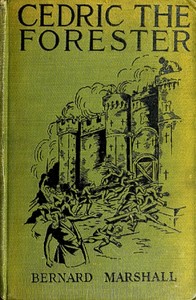
The source record for Cedric, the Forester — Edition Insights measures this digital text at 66,595 words, 4 hr 50 min estimated reading time, and 16 detected text sections.
The text analysis averages about 23.3 words per sentence, while the detected sections provide another way to judge how the source is divided.
Project Gutenberg metadata also associates the work with “Adventure stories,” connecting these edition facts with the source record’s subject description.
Explore this collection
These alternatives are selected using recorded categories and estimated reading time.
About 282 minutes
Adventure Picaresque Fiction
64,841 recorded words. 8 minutes difference from this book's estimate.
View Gutenberg source #24502About 273 minutes
Adventure Picaresque Fiction
62,779 recorded words. 17 minutes difference from this book's estimate.
View Gutenberg source #30390About 308 minutes
Adventure Picaresque Fiction
70,611 recorded words. 18 minutes difference from this book's estimate.
View Gutenberg source #32329Search stored excerpts and compare books → Choose by your preferences →
Choices use stored catalog measurements. Estimates vary with reading speed. A shared category is a catalog label, not a claim that two books have the same argument or literary quality.
Search reads excerpt text stored with this catalog and links to its associated Gutenberg record. The connection is stored in the site database; this tool does not recheck that every excerpt is word-for-word identical to that external record. Excerpt search does not cover every chapter and does not verify historical publication dates.
Catalog snapshot checked: 2026-09-26. Coverage: 99 public books, 99 available source excerpts.
Calculated from edition completeness, EPUB availability, text structure and catalogue metadata. Not a user rating.
Total of 100 points, scaled to a 2.5-5.0 range. Editions with an empty description or a missing EPUB file are not scored.
Public-domain source text
The source text is kept in the dedicated reader, separate from this catalogue record and its commentary.
The narrative of Cedric, the Forester opens with a blithe spring morning and a king's summons, but the action quickly shifts from the castle hall to the forest floor. The excerpts reveal a story built on rapid movement between settings: a siege at Castle Mountjoy gives way to a reconnaissance mission through bracken and underwood, where characters crouch, crawl, and climb oaks to spy on outlaws. This alternation between open conflict and stealthy observation shapes the book's rhythm.
The chapter titles—from "The Siege of Castle Mountjoy" to "The Fortress of the Monkslayer"—suggest a journey broken into discrete episodes. In the excerpts, the narrative moves from a campfire discussion of a dilemma to a whispered plan, then to a bow-shot away through the wood. Each scene is a self-contained unit of tension: the siege, the council, the stealthy approach. The transitions are abrupt, often marked by a character drawing another aside or by a change in light ("by sundown we stood again"). This structure keeps the reader oriented to immediate goals rather than long arcs.
Cedric is introduced as "native to these woods" and knowing them "as the very deer that run them." The forest is not a backdrop but an active element: characters move "crouching for shelter behind trees and rocks," cross "open spaces in stooping runs," and climb oaks to peer through leaves. The description of the outlaws' fortress—a "wide cavern at the head of yonder gully" reached only by a winding path—emphasizes concealment and natural defense. The forest dictates tactics; Cedric's knowledge of it is the key to every plan.
Reconnaissance is a repeated action. In Chapter VIII, the trio passes their own sentries, then creeps through the wood, with Cedric "crouch[ing] and crawl[ing] like a serpent" and laying a finger on his lips. They climb a tree to observe two archers in Lincoln green. Later, they retrace their steps without a word. This pattern—observe, withdraw, plan—appears twice in the excerpt. The motif extends to the siege: messengers "hurried out with his commands" and the campfire discussion is a form of strategic surveillance. Seeing without being seen is a core skill.
Dialogue in the excerpts is terse and functional. Cedric speaks "far more quickly than was his wont" when he has a plan; Geoffrey responds by drawing his cross-bow and saying "I will follow thee if 'tis to a lion's den." The exchange is stripped of ornament—"Hast thou any plan?" / "Aye, though 'tis something ticklish." This brevity mirrors the urgency of the situations and defines characters through their actions: Cedric leads, Geoffrey prepares, the narrator follows. The speech rhythms reinforce the forest setting, where noise is dangerous and words are kept to a minimum.
Readers approaching Cedric, the Forester should attend to how the narrative shifts between open combat and hidden movement. The forest is not merely a setting but a tactical space that shapes every decision. The episodic structure rewards attention to each scene's internal logic rather than a continuous plot. The excerpts suggest a story where knowledge of terrain and the ability to move silently are as important as swordplay.
There’s something about Marshall’s old forest tales that stays with you quietly, like the echo of footsteps between pines, the way his characters move from chase to quiet watch. It reminded me of another favorite, The Boy Scouts on the Range — A Reader’s Guide, which carried the same patient, open-air feeling long after I closed it. Some books just settle into your memory without ever raising their voice.
Save your reaction, strongest insight, and memorable passage.