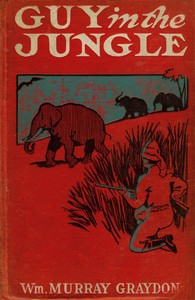
Guy in the Jungle; Or, A Boy's Adventure in the Wilds of Africa — Reading Notes
Edition facts
This digital edition of Guy in the Jungle; Or, A Boy's Adventure in the Wilds of Africa — Reading Notes is described by source-level measurements including 70,611 words, 5 hr 8 min estimated reading time, and 7 detected text sections.
The text analysis averages about 16.3 words per sentence, while the detected sections provide another way to judge how the source is divided.
Project Gutenberg metadata also associates the work with “Adventure stories,” connecting these edition facts with the source record’s subject description.
Calculated from edition completeness, EPUB availability, text structure and catalogue metadata. Not a user rating.
How this score is calculated
- Description quality20 pts
- Title & short description10 pts
- Source metadata20 pts
- Text length15 pts
- Chapters / structure15 pts
- EPUB file integrity20 pts
Total of 100 points, scaled to a 2.5-5.0 range. Editions with an empty description or a missing EPUB file are not scored.
Read the Text
THE STOLEN DESPATCHES.
Steadily the Cleopatra had traversed the Mediterranean, passed through the Suez Canal, plowed the burning waters of the Red Sea, and now, on this bright, sultry day, Aden was left behind, and with smoking funnels she was heading swiftly and boldly for the Indian Ocean.
A smaller steamer, a mere pigmy beside this gigantic Indian liner, had left the harbor of Aden at the same time, and was beating in a southwesterly direction across the gulf with a speed that was rapidly increasing the distance between the two vessels.
On the upper deck stood Guy Chutney, straining his eyes through a pair of field-glasses to catch a last glimpse of the Cleopatra, and to distinguish, if possible, the figures grouped under the white awnings. He had only arrived at Aden last night, and now he was bound for the dreary African coast, while all the gay friends he had made on board the Cleopatra were steaming merrily off for Calcutta without him.
It was by no means a comforting state of affairs, and Guy's spirits were at their lowest ebb as the steamer finally faded into the horizon. He put up the glasses and strode forward. From the lower deck came a confused babel of sounds, a harsh jabbering of foreign languages that grated roughly on his ear.
"This is a remarkably fine day, sir."
It was the captain who spoke, a bluff, hearty man, who looked oddly out of place in white linen and a solar topee.
"It is a grand day," said Guy. "May I ask when we are due at Zaila?"
"At Zaila?" repeated the captain, with a look of sudden surprise. "Ah, yes. Possibly tomorrow, probably not until the following day."
It was now Guy's turn to be surprised.
"Do you mean to tell me," he said, "that it takes two or three days to cross the Gulf of Aden?"
"No," replied the captain briskly. "You are surely aware, my dear sir, that we proceed first to Berbera, and thence up the coast to Zaila."
"Then you have deceived me, sir," cried Guy hotly. "You told me this morning that this steamer went to Zaila."
"Certainly I did," replied the captain. "You didn't ask for any more information, or I should have told you that we went to Berbera first. The great annual fair has just opened at Berbera, and I have on board large stores of merchandise and trading properties. On other occasions I go to Zaila first, but during the progress of the fair I always go direct to Berbera and unload. I supposed that fact to be generally understood," and, turning on his heel, the captain walked off to give some orders to his men.
Guy was half inclined to be angry at first, but on reflection he concluded he was just as well satisfied. Besides, it would give him a chance to see that wonderful African fair, which he now remembered to have heard about on different occasions.
But one other person was visible on the deck, a short, chunky man, with a dark complexion, and crafty, forbidding features.
A Portuguese or a Spaniard Guy put him down for at once, and he instantly conceived a deep mistrust of him. The fellow, however, was inclined to be sociable.
"Ah, an Englishman," he said, coming up to Guy and holding out his hand, an action which Guy professed not to see.
"You are going to Berbera, perhaps," he went on, nowise discomfited by the rebuff.
"No," said Guy shortly. "To Zaila."
"Ah, yes, Zaila! You have friends there, perhaps? I, too, am acquainted. I know very well Sir Arthur Ashby, the governor at Zaila."
His keen eyes scanned Guy's face closely, and noted the faint gleam of surprise at this information.
But Guy was too clever to be thrown off his guard.
"Yes," he said. "I know some people here. I have not the pleasure of Sir Arthur's acquaintance."
He would have turned away at this point, but the man pulled a card from his pocket and presented it to him. Guy glanced it over with interest:
C. MANUEL TORRES, _Trader at Aden and Berbera_.
"A vile Portuguese slave-hunter," he thought to himself.
"Well, Mr. Torres," he said. "I am sorry that I have no cards about me, but my name is Chutney."
The Portuguese softly whispered the name once or twice. Then, without further questioning, he offered Guy a cigar, and lit one himself.
Manuel Torres proved to be quite an interesting companion, and gave Guy a vivid account of the wonders of the fair.
As they went below at dinner time he pointed out on the corner of the dock a great stack of wooden boxes.
The catalog subjects for Guy in the Jungle list 'Africa,' 'Jungles,' and 'Adventure stories,' yet the excerpts reveal a narrative centered not on jungle trekking but on an underground river journey. The prologue opens in a foggy London hotel, introducing Captain Chutney—a bronzed young man with a drooping mustache—who receives official despatches. This urban start contrasts sharply with the later setting: a cavern with a swift, smooth river, sandy beaches, and 'gloomy holes and passages' piercing the walls. The adventure quickly moves from London to a subterranean waterway, suggesting the 'jungle' of the title may be more metaphorical than literal.
Underground River, Not Jungle Canopy
The excerpts depict a party traveling by canoe on an underground river, with 'sharp ledges falling sheer to the water' and 'sandy beaches' lining the shore. Characters fish for trumpet-colored fish, cook them over torch flames, and face dangers like a crocodile attack that drags a man underwater. The setting is a cavern, not an open jungle. The catalog subject 'Jungles—Juvenile fiction' implies dense vegetation and wildlife, but the text emphasizes darkness, water, and rock. The 'jungle' appears only in the title and chapter headings like 'The Isle of Skeletons' and 'The End of the Cavern.' Readers expecting Tarzan-like forest scenes will find instead a claustrophobic river odyssey.
Slavery and Escape as Core Action
Chapter titles such as 'Sold into Slavery,' 'The Slave Prison,' and 'The Flight Through the Town' indicate that captivity and escape are central plot drivers. The catalog subject 'Adventure stories' fits, but the specific nature of the adventure—slavery, pursuit, and underground flight—is more specific than generic jungle adventure. In one excerpt, a character describes being dragged into a river by a monster, a 'close shave' that underscores physical peril. The narrative focuses on survival against human and natural threats, not exploration or discovery. The 'wilds of Africa' serve as a backdrop for a captivity narrative rather than a wilderness expedition.
Character Roles and Dialogue Patterns
The excerpts reveal a cast with distinct roles: the young hero Guy, the experienced Colonel, the nervous Sir Arthur, and the Greek Canaris. Dialogue often serves to advance the plot or express fear, as when Sir Arthur laments, 'It makes me think of white-bait dinners at Greenwich.' This contrast between civilized nostalgia and immediate danger is a recurring device. The narrative voice is omniscient and slightly formal, with phrases like 'Well may he hesitate to break that official seal.' The catalog does not capture this tonal blend of Victorian adventure and personal anxiety. The characters' interactions—such as Guy suggesting fishing to pass time—show a focus on practical survival rather than character development.
Readers approaching Guy in the Jungle through its catalog subjects should adjust expectations: the 'jungle' is a cavern river, the 'Africa' is a setting for a slavery-and-escape plot, and the 'adventure' is more about endurance than exploration. The excerpts show a work that uses its exotic locale for suspense rather than natural history. This note encourages attention to the underground setting and the captivity theme, which are more prominent than the catalog suggests.
I keep thinking about how Graydon's jungle promised exploration but delivered darker currents—an underground river, human bondage. That mismatch reminds me of when I first read The Red Cross Girls with Pershing to Victory — Inside the Classic, expecting tidy heroics yet finding mud, exhaustion, and quiet endurance instead. Both books taught me that adventure's real weight often hides beneath its bright, advertised surface.
There are no reviews for this eBook.
Your personal reading reflection
Build a private reading journal entry for this title.