About 180 minutes
The Young Berringtons: The Boy Explorers — Key Ideas to Explore
Adventure Picaresque Fiction
41,225 recorded words. 10 minutes difference from this book's estimate.
View Gutenberg source #25524
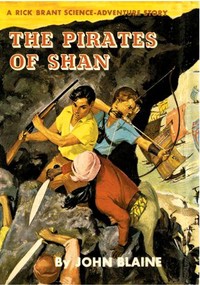
The source record for The Pirates of Shan: A Rick Brant Science-Adventure Story — Story, Setting & Ideas measures this digital text at 43,684 words, 3 hr 10 min estimated reading time, and 5 detected text sections.
The text analysis averages about 11.6 words per sentence, while the detected sections provide another way to judge how the source is divided.
Project Gutenberg metadata also associates the work with “Detective and mystery stories,” connecting these edition facts with the source record’s subject description.
Explore this collection
These alternatives are selected using recorded categories and estimated reading time.
About 180 minutes
Adventure Picaresque Fiction
41,225 recorded words. 10 minutes difference from this book's estimate.
View Gutenberg source #25524About 208 minutes
Adventure Picaresque Fiction
47,809 recorded words. 18 minutes difference from this book's estimate.
View Gutenberg source #33990About 208 minutes
Adventure Picaresque Fiction
47,758 recorded words. 18 minutes difference from this book's estimate.
View Gutenberg source #37972Search stored excerpts and compare books → Choose by your preferences →
Choices use stored catalog measurements. Estimates vary with reading speed. A shared category is a catalog label, not a claim that two books have the same argument or literary quality.
Search reads excerpt text stored with this catalog and links to its associated Gutenberg record. The connection is stored in the site database; this tool does not recheck that every excerpt is word-for-word identical to that external record. Excerpt search does not cover every chapter and does not verify historical publication dates.
Catalog snapshot checked: 2026-09-26. Coverage: 99 public books, 99 available source excerpts.
Calculated from edition completeness, EPUB availability, text structure and catalogue metadata. Not a user rating.
Total of 100 points, scaled to a 2.5-5.0 range. Editions with an empty description or a missing EPUB file are not scored.
Public-domain source text
The source text is kept in the dedicated reader, separate from this catalogue record and its commentary.
The opening chapter establishes a tone of restrained urgency through Rick Brant's terse dialogue: "We'd better do something, and we'd better do it fast." The narrative voice quickly distinguishes between the public perception of the Spindrift Foundation—"impersonal and efficient"—and its internal reality as a close-knit family. This contrast is reinforced by the physical setting: the green waters of the Atlantic off Spindrift Island, where Rick throws a stone in a gesture that "did little to relieve his worry." The author uses the scientists' disappearance not as a mystery to be pondered but as a catalyst for immediate action, a choice that shapes the story's forward momentum.
Goodwin differentiates his young protagonists through their speech patterns. Rick Brant's lines are often imperative or declarative, reflecting his impatience: "We'd better do something." Don Scott, nicknamed Scotty, responds with soothing, analytical phrases: "I know how you feel. But don't forget that Dad is just as worried as we are." The Hindu boy Chahda uses a distinctive syntax—"We not miss any islands"—that marks him as a non-native speaker without resorting to stereotype. Even the adult scientist Hobart Zircon speaks in measured, precise terms: "There's only one island group remaining in this immediate area." These vocal tics create a quick, reliable sense of each character's role within the group dynamic.
The narrative is dense with nautical and scientific terminology that serves both authenticity and plot. Terms like vinta (a traditional outrigger boat), kris (a wavy-bladed dagger), and MTB (motor torpedo boat) are used without explanation, trusting the reader to infer meaning from context. The characters discuss engine throttle, chart plotting, and fuel capacity with casual expertise: "If we use both engines, someone had better keep watch from on top of the pilothouse." This technical language is not ornamental; it drives the search procedure, as when Zircon systematically eliminates island groups on a chart. The author's choice to embed exposition in dialogue—"These Datu Amman islands aren't very big"—keeps the story moving while conveying necessary information.
The Sulu Sea and Celebes Sea are rendered through specific, observable phenomena rather than generic description. Rick watches "a school of flying fish break water from under the MTB's bow" and spots sharks, including a hammerhead. The calm day is defined by the absence of whitecaps, and the approach of land is signaled by "the tips of palms" visible above a coral atoll. These details ground the adventure in a tangible environment. The author also uses the characters' physical actions to convey setting: Rick sits in a canvas chair handed up by Zircon, using "Shannon's long glass" to sweep the horizon. Such small props and gestures—a borrowed telescope, a centavo coin used for a coin toss—build a world that feels inhabited rather than merely described.
Goodwin structures the search around elapsed time and travel logistics, creating a rhythm of anticipation and resolution. The characters calculate arrival times: "If we use both engines, then we can get there before dark." The afternoon "wore on without sign of a sail," and Rick checks his watch to estimate when they should sight the islands. This temporal framework gives the search a procedural feel, as if the reader is following a real expedition. The author also uses time to build tension through routine actions—making sandwiches, drinking cold cokes, taking turns at watch—that contrast with the underlying danger. The sudden cry of "Sail ho" breaks this routine, and the subsequent sighting of land behind the vinta is presented as a natural consequence of the plotted course, not a coincidence.
Readers approaching The Pirates of Shan will find a story that rewards attention to its technical and geographical specifics. The author's choices in dialogue, vocabulary, and pacing create a coherent world where every detail—from the type of boat to the color of the sea—serves the narrative. This is a work that trusts its audience to follow along with chart coordinates and engine decisions, offering a model of adventure fiction that values competence and observation over melodrama.
Reading about the careful nautical talk in The Pirates of Shan, the way each rope and current had its proper name, I felt that same quiet satisfaction from a different shelf—Guy in the Jungle; Or, A Boy's Adventure in the Wilds of Africa — Reading Notes. Both hold that patient, unnamed knowledge of a place, learned not from maps but from living in it.
Build a private reading journal entry for this title.