About 299 minutes
For the School Colours — A Closer Reading
Fantasy Juvenile Worlds
68,704 recorded words. 3 minutes difference from this book's estimate.
View Gutenberg source #35972
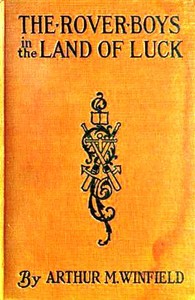
Before opening The Rover Boys in the Land of Luck; Or, Stirring Adventures in the Oil Fields — Context and Discussion, the edition data offers a quick orientation: 68,029 words, 4 hr 56 min estimated reading time, and 7 detected text sections.
The text analysis averages about 13.8 words per sentence, while the detected sections provide another way to judge how the source is divided.
Project Gutenberg metadata also associates the work with “Cousins -- Juvenile fiction,” connecting these edition facts with the source record’s subject description.
Explore this collection
These alternatives are selected using recorded categories and estimated reading time.
About 299 minutes
Fantasy Juvenile Worlds
68,704 recorded words. 3 minutes difference from this book's estimate.
View Gutenberg source #35972About 290 minutes
Fantasy Juvenile Worlds
66,604 recorded words. 6 minutes difference from this book's estimate.
View Gutenberg source #25778About 302 minutes
Fantasy Juvenile Worlds
69,326 recorded words. 6 minutes difference from this book's estimate.
View Gutenberg source #33263Search stored excerpts and compare books → Choose by your preferences →
Choices use stored catalog measurements. Estimates vary with reading speed. A shared category is a catalog label, not a claim that two books have the same argument or literary quality.
Search reads excerpt text stored with this catalog and links to its associated Gutenberg record. The connection is stored in the site database; this tool does not recheck that every excerpt is word-for-word identical to that external record. Excerpt search does not cover every chapter and does not verify historical publication dates.
Catalog snapshot checked: 2026-09-26. Coverage: 99 public books, 99 available source excerpts.
Calculated from edition completeness, EPUB availability, text structure and catalogue metadata. Not a user rating.
Total of 100 points, scaled to a 2.5-5.0 range. Editions with an empty description or a missing EPUB file are not scored.
Public-domain source text
The source text is kept in the dedicated reader, separate from this catalogue record and its commentary.
Edward Stratemeyer's The Rover Boys in the Land of Luck (1919) opens with a domestic scene that quickly pivots to a discussion of a victory parade for returning soldiers, before the narrative promises to shift to the oil fields of Texas. The excerpt reveals a tension between the comforts of home and the allure of risk—a pattern that recurs throughout the series. The author's introduction explicitly frames the volume as part of a series, noting that the younger Rovers have moved from school adventures to wartime service, and now to speculative enterprise. This note focuses on three observable tensions: the contrast between family dialogue and action, the treatment of war as both backdrop and spectacle, and the rhetorical construction of the oil fields as a space of luck and danger.
The excerpt opens with a rapid exchange among the Rover cousins about joining a trip to the oil fields. Fred dismisses the girls' interest by joking that a well might "shoot all your beautiful dresses full of oil." His sister Mary retorts by mocking his "flaming red necktie." This banter establishes a familiar, affectionate tone—one that relies on shared history and mild teasing. Yet the conversation is immediately undercut by Dick Rover's announcement that he must leave for Hoboken, and the promise of a parade. The domestic sphere is presented as a launching pad, not a destination. The narrative voice treats family life as a prelude to action, not its center. The oil fields, by contrast, are described only in the title and author's introduction as a place of "stirring adventures" and "luck." The reader is left to infer that the real story lies beyond the family circle, in a landscape of speculation and hazard.
The parade scene occupies a substantial portion of the excerpt, yet it functions as a set piece rather than a plot driver. The crowd is described in general terms: "dense crowds that filled miles of grandstands." The Rover family secures seats, and Grandfather Rover declares it "the greatest day of my life" because his boys have returned safely. One son has won a medal. The language is celebratory but generic—flags, decorations, a holiday. The parade is a backdrop for family reunion, not a moment of individual heroism. Notably, the girls invite friends to watch, but Ruth cannot attend due to her eyes being "still in bad condition." This detail hints at a cost of war that the parade itself glosses over. The narrative uses the parade to reinforce family bonds and national pride, but it also suggests that the real action—the war itself—is already past. The oil fields, then, become a new frontier for the younger generation, one where luck, not duty, will determine outcomes.
The title promises "Stirring Adventures in the Oil Fields," and the author's introduction frames the volume as a shift from school and camp to a commercial frontier. Yet the excerpt contains no oil-field action. Instead, the reader encounters a family discussing a parade and a trip to Texas. The oil fields are invoked only as a destination, a place of potential danger ("a well might go off") and profit. The word "luck" in the title suggests that success in this landscape is contingent, not earned. The author's note thanks readers for their support of the series, reinforcing the commercial context of the book itself. The tension here is between the known world of family and school and the unknown world of oil speculation—a world the narrative has not yet entered. The reader is left waiting for the promised adventure, aware that the domestic scenes are a prelude to a more uncertain, and perhaps more thrilling, terrain.
Stratemeyer's introduction explicitly situates this volume within the "Second Rover Boys Series," referencing previous books set at Colby Hall, on Snowshoe Island, under canvas, and on a hunt. The author assumes familiarity with the characters and their history. The excerpt reinforces this: the cousins are distinguished by their relationships (Jack, Fred, Andy, Randy, Martha, Mary) and by ongoing jokes (the necktie). The parade scene includes Grandfather Rover, Aunt Martha, and Uncle Randolph—characters from earlier volumes. The narrative does not pause to explain who these people are. This reliance on series continuity shapes the reading experience: the book is not a standalone story but an installment. The oil-field adventure is the new element, but it is framed by established patterns of family interaction and adventure. Readers who have followed the series will recognize the formula; new readers may find the domestic scenes a necessary entry point into a larger world.
The excerpt offers a narrow window into a novel that promises more than it delivers in these pages. The parade scene and family banter establish a baseline of comfort and camaraderie against which the oil-field adventure will presumably be measured. Readers attentive to the series' conventions will note how Stratemeyer balances domestic stability with the lure of risk. The tension between the known and the unknown, the safe and the speculative, is the engine that drives the narrative forward—even when the oil fields themselves remain just out of sight.
Reading about the Rover boys’ parade made me think of my grandfather’s stories of oil-town drilling rigs, the same giddy suspense in his voice. That heavy, promised horizon of luck and risk—I felt it once before in Clematis — Text and Context, where a garden gate hid a similar wildness. Both books keep that patient hum under the adventure.
Your answers remain private and are stored only in this browser.