About 336 minutes
The Revolt of the Angels — Key Ideas to Explore
Science Fiction Utopias
77,221 recorded words. 2 minutes difference from this book's estimate.
View Gutenberg source #32596
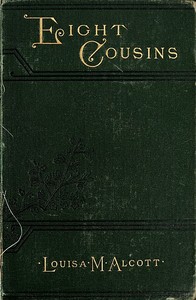
The catalog record for Eight Cousins; Or, The Aunt-Hill — Edition Insights provides practical reading context through 77,547 words, 5 hr 38 min estimated reading time, and 9 detected text sections.
The text analysis averages about 21.7 words per sentence, while the detected sections provide another way to judge how the source is divided.
Project Gutenberg metadata also associates the work with “Orphans -- Juvenile fiction,” connecting these edition facts with the source record’s subject description.
Explore this collection
These alternatives are selected using recorded categories and estimated reading time.
About 336 minutes
Science Fiction Utopias
77,221 recorded words. 2 minutes difference from this book's estimate.
View Gutenberg source #32596About 347 minutes
Science Fiction Utopias
79,663 recorded words. 9 minutes difference from this book's estimate.
View Gutenberg source #24010About 316 minutes
Science Fiction Utopias
72,641 recorded words. 22 minutes difference from this book's estimate.
View Gutenberg source #36934Search stored excerpts and compare books → Choose by your preferences →
Choices use stored catalog measurements. Estimates vary with reading speed. A shared category is a catalog label, not a claim that two books have the same argument or literary quality.
Search reads excerpt text stored with this catalog and links to its associated Gutenberg record. The connection is stored in the site database; this tool does not recheck that every excerpt is word-for-word identical to that external record. Excerpt search does not cover every chapter and does not verify historical publication dates.
Catalog snapshot checked: 2026-09-26. Coverage: 99 public books, 99 available source excerpts.
Calculated from edition completeness, EPUB availability, text structure and catalogue metadata. Not a user rating.
Total of 100 points, scaled to a 2.5-5.0 range. Editions with an empty description or a missing EPUB file are not scored.
Public-domain source text
The source text is kept in the dedicated reader, separate from this catalogue record and its commentary.
Despite its catalog classification as Science Fiction & Utopias, Louisa May Alcott's Eight Cousins opens with a scene of solitary grief in a parlor hung with portraits of "solemn old gentlemen in wigs" and "severe-nosed ladies." The orphaned heroine, Rose, sits with a handkerchief ready for tears, a detail that immediately establishes the domestic and emotional register of the work. The preface itself acknowledges the story first appeared serially and was meant "to amuse the young folks," not to suggest educational reforms. Readers expecting speculative fiction will find instead a family chronicle centered on the Campbell clan.
The catalog subjects list orphans, cousins, and family life—all present in the excerpts. Yet the primary category is Science Fiction & Utopias, a label that finds no support in the provided text. The opening chapter, titled "Two Girls," introduces Rose in a parlor full of antique furniture and portraits, with rain pattering sympathetically on the window. The narrative voice is firmly rooted in 19th-century domestic realism, describing the aunts' efforts to make Rose happy and her unfamiliarity with their world. The subtitle "The Aunt-Hill" hints at the comedic structure: a cluster of aunts overseeing a single niece. No element of science fiction or utopian speculation appears in the excerpts. The mismatch likely reflects Project Gutenberg's broad categorization, but readers should note that the work is a conventional family story.
The longest excerpt depicts a family game of charades, a set piece that reveals Alcott's skill with dialogue and physical comedy. The children perform scenes from "Puss in Boots," "Balaam and the Ass," and "Babes in the Wood." The descriptions are precise: a character wears a brown-paper bag over its head with "a little pink nose peep[ing] through one hole," and another lies on a stone complaining that "ants are walking up my leg like fury." The children direct each other audibly, breaking the fourth wall. This passage showcases Alcott's ear for childish speech and her willingness to let humor undercut sentiment. The charades also serve as a microcosm of the family dynamics—the boys take lead roles, while Rose plays an angel and receives a compliment that makes her smile "with mundane satisfaction." The scene is self-contained and does not advance a larger plot, but it demonstrates the book's reliance on episodic, domestic entertainment.
Alcott's preface is unusually candid: she acknowledges "defects" in the story, many "unavoidable" due to serial publication, and promises to "make amends in a second volume" titled Rose in Bloom. This frames Eight Cousins as an incomplete arc, a setup for a sequel. The excerpts support this: the opening establishes Rose's orphaned state and her placement with aunts, but the charades scene—drawn from later in the book—shows her integrated into the cousin group without explaining how she got there. Key plot points, such as the introduction of Uncle Alec or the resolution of Rose's grief, are absent from the provided text. Readers should expect a leisurely, episodic narrative that prioritizes character interaction over sustained conflict. The catalog subject "orphans" is accurate but reductive; the excerpts suggest the book is more concerned with the social comedy of a large family than with the psychology of loss.
The excerpts from Eight Cousins offer a narrow but vivid sample of Alcott's domestic comedy. Readers should approach the book as a serialized family story, not a utopian or speculative work. The charades scene, in particular, rewards attention to Alcott's use of physical humor and child dialogue. The preface's promise of a sequel indicates that the narrative may feel unresolved; those interested in Rose's full story should seek out Rose in Bloom. The catalog mismatch serves as a reminder that genre labels in digital libraries can be misleading.
Years among these shelves taught me that Rose’s world of bustling aunts and playful cousins carries the same warm friction of tents and tides in The Go Ahead Boys on Smugglers' Island — Story, Setting & Ideas. Both are simply about finding belonging within a boisterous company, and I’ve always quietly cherished that echo.
Save your reaction, strongest insight, and memorable passage.