About 293 minutes
Elsie at Viamede — Text and Context
Historical Psychological Social Fiction
67,217 recorded words. 5 minutes difference from this book's estimate.
View Gutenberg source #32225
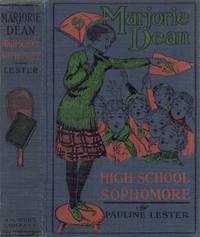
This digital edition of Marjorie Dean, High School Sophomore — Background and Themes is described by source-level measurements including 68,316 words, 4 hr 58 min estimated reading time, and 7 detected text sections.
The text analysis averages about 14.0 words per sentence, while the detected sections provide another way to judge how the source is divided.
Project Gutenberg metadata also associates the work with “Schools -- Juvenile fiction,” connecting these edition facts with the source record’s subject description.
Explore this collection
These alternatives are selected using recorded categories and estimated reading time.
About 293 minutes
Historical Psychological Social Fiction
67,217 recorded words. 5 minutes difference from this book's estimate.
View Gutenberg source #32225About 304 minutes
Historical Psychological Social Fiction
69,886 recorded words. 6 minutes difference from this book's estimate.
View Gutenberg source #31419About 304 minutes
Historical Psychological Social Fiction
69,886 recorded words. 6 minutes difference from this book's estimate.
View Gutenberg source #32731Search stored excerpts and compare books → Choose by your preferences →
Choices use stored catalog measurements. Estimates vary with reading speed. A shared category is a catalog label, not a claim that two books have the same argument or literary quality.
Search reads excerpt text stored with this catalog and links to its associated Gutenberg record. The connection is stored in the site database; this tool does not recheck that every excerpt is word-for-word identical to that external record. Excerpt search does not cover every chapter and does not verify historical publication dates.
Catalog snapshot checked: 2026-09-26. Coverage: 99 public books, 99 available source excerpts.
Calculated from edition completeness, EPUB availability, text structure and catalogue metadata. Not a user rating.
Total of 100 points, scaled to a 2.5-5.0 range. Editions with an empty description or a missing EPUB file are not scored.
Public-domain source text
The source text is kept in the dedicated reader, separate from this catalogue record and its commentary.
The catalog subjects for Marjorie Dean, High School Sophomore list 'Schools -- Juvenile fiction,' 'High school students -- Juvenile fiction,' and 'Best friends -- Juvenile fiction.' The opening chapters, however, reveal a more complicated picture of friendship than the subject heading might suggest. The narrative begins with a seaside scene where Marjorie Dean playfully drags her friend Constance Stevens into the water, declaring swimming 'as important as being a sophomore in Sanford High.' This lighthearted moment quickly gives way to tension when Mary, Marjorie's childhood friend, arrives and feels displaced by Connie. The excerpts show that the story is less about the simple joys of school and friendship and more about the painful process of navigating jealousy, loyalty, and misunderstanding among three girls.
The excerpts span from a sunny August morning at the beach to a tense breakfast scene at the Dean home. The opening chapter establishes Marjorie's energetic, commanding voice—she calls herself a 'stern duty' to teach Connie to swim, using phrases like 'sink or swim, survive or perish.' This playful authority contrasts sharply with the later breakfast scene, where Marjorie is 'between two fires' and speaks 'through a mist of tears.' The shift in setting from open beach to domestic table mirrors the shift from carefree friendship to strained loyalty. The breakfast confrontation, with Mrs. Dean acting as 'Captain' to her 'soldiers,' reveals a family dynamic where conflicts are aired and resolved through direct conversation—a pattern that may recur throughout the novel.
The excerpts provide a detailed account of how the friendship triangle develops. Marjorie explains that she did not write to Mary about her friendship with Connie because she 'wished her to know only the pleasant side of my school life.' This well-intentioned omission leads Mary to believe Connie has 'taken her place.' The narrative traces the misunderstanding through specific actions: Marjorie asking Connie to meet Mary at the station, Mary's jealousy, and Marjorie's promise to tell Mary about the previous year's events—a promise complicated by Connie's request for secrecy. The dialogue is precise: Mary says 'Why don't you say "jealous"?' and Marjorie quietly agrees. The excerpts show that the conflict is not driven by malice but by a series of small, plausible decisions that accumulate into estrangement.
Mrs. Dean functions as an active mediator, not a passive background figure. She declares, 'Things cannot go on in this way. You must take me into your confidence.' Her military metaphors—'Lieutenant, it is your turn'—echo Marjorie's earlier playful command of Connie at the beach, suggesting a family culture of structured problem-solving. The excerpts also reveal a narrative technique: the story is told through dialogue and interior conflict rather than action. The breakfast scene is essentially a long conversation where feelings are articulated and confronted. This reliance on verbal resolution may be a recurring structural feature. Notably, the excerpts do not show any school setting yet, despite the catalog subject 'Schools -- Juvenile fiction'; the focus remains firmly on the friendship dynamics that presumably play out within the school context later.
The excerpts end with Mary's 'half-stifled exclamation of anger' and a shrug of 'inimitable contempt,' leaving the breakfast confrontation unresolved. The reader does not learn whether Mary softens or whether the three girls reconcile. The catalog subject 'Best friends -- Juvenile fiction' implies a positive outcome, but the excerpts show only the breakdown. The narrative also introduces a 'lost butterfly pin' from the previous year—a plot device that caused 'unhappy days' between Marjorie and Connie—but the excerpts do not reveal its significance. Readers approaching the full text should expect that the resolution of the current conflict may involve revisiting that earlier incident. The school setting, promised by the title and catalog, has not yet appeared in the excerpts; the story begins firmly in the domestic and recreational sphere.
Readers should note that the excerpts represent only the first two chapters of a twenty-seven-chapter novel. The catalog subjects accurately reflect the book's concerns, but the opening chapters emphasize emotional conflict over school activities. The narrative voice is direct and dialogue-heavy, with characters openly stating their feelings—a style that may appeal to readers interested in interpersonal drama rather than plot-driven adventure. The resolution of the friendship triangle, hinted at by chapter titles like 'The Compact' and 'Hoisting the Flag of Truce,' likely follows the pattern of confrontation and reconciliation established in these early pages.
I keep thinking about that editorial note on Marjorie Dean—how the catalog promises “best friends” while the story quietly shows jealousy. It reminded me of The School by the Sea, whose introduction muses on similar gaps between school-story ideals and real, messy affection. That tender mismatch stays with me, like an old photograph slightly out of focus but achingly true. The School by the Sea — Edition Insights frames that tension so gently, almost like a sigh.
Capture what you thought, learned, and would like to remember.