About 209 minutes
Maid Sally — A Reader’s Guide
Historical Psychological Social Fiction
47,968 recorded words. 4 minutes difference from this book's estimate.
View Gutenberg source #32336
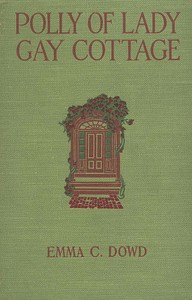
The catalog record for Polly of Lady Gay Cottage — Edition Insights provides practical reading context through 48,835 words, 3 hr 33 min estimated reading time, and 6 detected text sections.
The text analysis averages about 12.8 words per sentence, while the detected sections provide another way to judge how the source is divided.
Project Gutenberg metadata also associates the work with “Orphans -- Juvenile fiction,” connecting these edition facts with the source record’s subject description.
Explore this collection
These alternatives are selected using recorded categories and estimated reading time.
About 209 minutes
Historical Psychological Social Fiction
47,968 recorded words. 4 minutes difference from this book's estimate.
View Gutenberg source #32336About 219 minutes
Historical Psychological Social Fiction
50,167 recorded words. 6 minutes difference from this book's estimate.
View Gutenberg source #27096About 231 minutes
Historical Psychological Social Fiction
52,925 recorded words. 18 minutes difference from this book's estimate.
View Gutenberg source #28331Search stored excerpts and compare books → Choose by your preferences →
Choices use stored catalog measurements. Estimates vary with reading speed. A shared category is a catalog label, not a claim that two books have the same argument or literary quality.
Search reads excerpt text stored with this catalog and links to its associated Gutenberg record. The connection is stored in the site database; this tool does not recheck that every excerpt is word-for-word identical to that external record. Excerpt search does not cover every chapter and does not verify historical publication dates.
Catalog snapshot checked: 2026-09-26. Coverage: 99 public books, 99 available source excerpts.
Calculated from edition completeness, EPUB availability, text structure and catalogue metadata. Not a user rating.
Total of 100 points, scaled to a 2.5-5.0 range. Editions with an empty description or a missing EPUB file are not scored.
Public-domain source text
The source text is kept in the dedicated reader, separate from this catalogue record and its commentary.
The telephone bell that cuts into Polly's story in the first chapter signals a pattern of abrupt interruptions that punctuate the novel. A rosewood box, carried by an injured man, becomes the catalyst for revelations about Polly's mother. Dowd's prose moves briskly through dialogue, often letting characters' speech carry emotional weight—Polly's troubled face, the doctor's grave answers, and the injured man's insistence on seeing her create a tight, urgent scene.
Later, the hospital setting introduces a different rhythm. Polly's visit to little Chris, a boy with sky-blue eyes and red-gold hair, unfolds in hesitant exchanges. The boy's fear for his father and Polly's cheerful reassurances reveal a quieter, more tender voice. These contrasting paces—one driven by plot mechanics, the other by character vulnerability—define the novel's narrative texture.
The novel opens with a telephone call that halts Polly's story mid-sentence. This is not a one-time device. Throughout the excerpts, characters are repeatedly pulled from one scene to another by messages, arrivals, or emergencies. The injured Mr. Bean's demand to see Polly overrides the doctor's medical judgment. Later, the father of little Chris arrives only in the evening, and his departure is timed to his son's sleep. These interruptions create a sense of lives lived at the mercy of external events.
Dowd uses them to control pacing. The first chapter's rapid sequence—story, call, hospital, revelation—compresses time and emotion. In contrast, the hospital scenes stretch out, with pauses for silent tears, shy smiles, and careful questions. The interruptions also serve as transitions between Polly's domestic world and the hospital's institutional setting, each with its own tempo.
Polly's speech is direct and colloquial. She says, “I guess he’s glad to get away from her, if he did have to be hurt to do it,” a bluntness that contrasts with the guarded responses of adults. Her dialogue drives the narrative forward, often asking questions that prompt revelations. In the hospital, her tone shifts to coaxing: “I’ve been wanting to come in before.”
Little Chris speaks in a softer, more hesitant register. His replies are often single words or short phrases: “Only a wee nod,” “A faint smile.” When he does speak at length, it is about his father, with a vulnerability that Polly lacks. The attending nurse overhears his father's parting words—“Keep up a big bluff!”—a phrase that reveals a different, more performative voice. These contrasts in dialogue create distinct character identities and emotional textures.
The hospital setting slows the narrative. Where the opening chapters move through events in quick succession, the hospital scenes linger on details: the boy's “sky-blue eyes and the red-gold hair,” the silent tears, the careful negotiation of fear. Polly's visit to Chris is structured around pauses—a nod, a smile, a long silence before talk flourishes. The pace mirrors the slow fever from which Chris suffers.
Dowd also uses the hospital to introduce a different kind of tension. Chris's fear that something might happen to his father while he cannot protect him introduces a note of helplessness absent from the earlier, more action-driven plot. The nurse's observation of the parting and the boy's subsequent tears create a quiet, almost cinematic scene. This shift in pace from external events to internal emotion is a key feature of the novel's narrative architecture.
Readers attentive to shifts in tempo will find the novel's emotional core in its quieter moments. The hospital scenes, in particular, reward close attention to dialogue and gesture. Dowd's use of interruption as a structural principle means that no scene feels static, but the most revealing exchanges often occur in the gaps between events. Approach the text with an ear for who speaks, how they speak, and when they fall silent.
There’s something about Polly’s quiet courage, especially around little Chris, that stays with you long after the rosewood box is closed. It reminded me of that other old favorite, Wyn's Camping Days; Or, The Outing of the Go-Ahead Club — Inside the Classic, where the same gentle pluck shows up under open skies. Different season, same steady heart.
Create a short personal record of your experience with this book.