About 267 minutes
Jessica Trent: Her Life on a Ranch — Story, Setting & Ideas
Historical Psychological Social Fiction
61,224 recorded words. 0 minutes difference from this book's estimate.
View Gutenberg source #33853
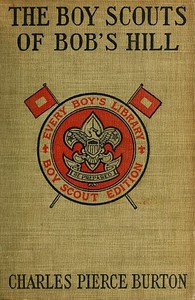
The source record for The Boy Scouts of Bob's Hill A Sequel to 'The Bob's Hill Braves' — A Reader’s Guide measures this digital text at 61,296 words, 4 hr 27 min estimated reading time, and 8 detected text sections.
The text analysis averages about 14.5 words per sentence, while the detected sections provide another way to judge how the source is divided.
Project Gutenberg metadata also associates the work with “Camping -- Juvenile fiction,” connecting these edition facts with the source record’s subject description.
Explore this collection
These alternatives are selected using recorded categories and estimated reading time.
About 267 minutes
Historical Psychological Social Fiction
61,224 recorded words. 0 minutes difference from this book's estimate.
View Gutenberg source #33853About 275 minutes
Historical Psychological Social Fiction
63,096 recorded words. 8 minutes difference from this book's estimate.
View Gutenberg source #33909About 251 minutes
Historical Psychological Social Fiction
57,728 recorded words. 16 minutes difference from this book's estimate.
View Gutenberg source #30914Search stored excerpts and compare books → Choose by your preferences →
Choices use stored catalog measurements. Estimates vary with reading speed. A shared category is a catalog label, not a claim that two books have the same argument or literary quality.
Search reads excerpt text stored with this catalog and links to its associated Gutenberg record. The connection is stored in the site database; this tool does not recheck that every excerpt is word-for-word identical to that external record. Excerpt search does not cover every chapter and does not verify historical publication dates.
Catalog snapshot checked: 2026-09-26. Coverage: 99 public books, 99 available source excerpts.
Calculated from edition completeness, EPUB availability, text structure and catalogue metadata. Not a user rating.
Total of 100 points, scaled to a 2.5-5.0 range. Editions with an empty description or a missing EPUB file are not scored.
Public-domain source text
The source text is kept in the dedicated reader, separate from this catalogue record and its commentary.
The narrative voice of The Boy Scouts of Bob's Hill is its most distinctive feature: a collective first-person plural (“we boys”) that frames the story as a shared recollection. This voice is not uniform, however. The boys’ dialogue is peppered with colloquialisms like “Aw, g'wan!” and “Great snakes!”, while the narrator’s commentary often adopts a more measured, almost instructional tone—especially when explaining Scout principles. The result is a text that shifts between the immediacy of a campfire tale and the didacticism of a manual.
The narrator’s “we” is a collective that includes the reader in the boys’ adventures, but individual characters emerge through their speech. Skinny, for instance, uses a defensive, boastful cadence: “What, me?” and “Anyhow, I wouldn't have been, only there were all kinds of noises.” Bill counters with playful skepticism, as when he tallies Skinny’s free meals. The adult Mr. Norton speaks in a more formal register, using phrases like “the psychological moment” and “I think that he has earned a badge.” This contrast between the boys’ vernacular and the Scoutmaster’s polished language creates a layered narrative where authority and youthful bravado constantly negotiate.
The story’s rhythm alternates between extended outdoor sequences—like Skinny’s solitary hike through the Hoosac Valley—and indoor scenes where the troop gathers to debrief. The hike passage slows time with sensory details: “mountain brook, gurgling and singing over the stones,” the “sweetest music” of water, and the “cawing of a crow.” In contrast, the fireside exchanges accelerate through quick dialogue and interruptions, as when Benny asks, “What's a skological moment?” This shift from descriptive immersion to rapid-fire banter keeps the narrative from becoming static, mirroring the boys’ own restless energy.
Scout ceremonies punctuate the adventure with moments of formal recognition. Mr. Norton’s presentation of a First Class badge to Skinny is staged as a “psychological moment,” complete with a badge pinned to the coat. The scene is both earnest and gently comic: Skinny’s earlier bravado about rescuing a girl and carrying wood is retroactively framed as “pay as you go” Scout work. The badge becomes a narrative device that translates the boys’ chaotic exploits into a structured system of merit. Yet the text undercuts this solemnity with Benny’s malapropism, reminding readers that the boys are still learning the language of Scouting.
Readers should attend to how the narrator’s “we” shifts between inclusive storytelling and a more distant, instructional voice. The book rewards those who listen for the differences between what the boys say and how the narrator describes them. The pacing, too, offers a clue to the book’s dual purpose: to entertain with adventure and to model the Scout law in action.
Reading about the Bob's Hill boys and their scraped-knee adventures, I remembered the summer I spent alone in my grandmother’s attic, finding a dusty copy of The Girls of Hillcrest Farm; Or, The Secret of the Rocks — A Closer Reading. Both books share that same patient hush—the feeling of a campfire settling, where every knot and stone holds a quiet promise few grown-ups notice.
Save your reaction, strongest insight, and memorable passage.