About 327 minutes
Elsie's Widowhood A Sequel to Elsie's Children — Key Ideas to Explore
Historical Psychological Social Fiction
74,999 recorded words. 11 minutes difference from this book's estimate.
View Gutenberg source #38353
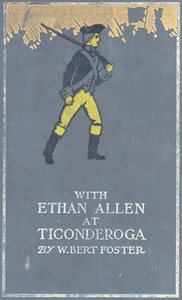
The source record for With Ethan Allen at Ticonderoga — Reading Notes measures this digital text at 72,467 words, 5 hr 16 min estimated reading time, and 7 detected text sections.
The text analysis averages about 18.4 words per sentence, while the detected sections provide another way to judge how the source is divided.
Project Gutenberg metadata also associates the work with “Historical fiction,” connecting these edition facts with the source record’s subject description.
Explore this collection
These alternatives are selected using recorded categories and estimated reading time.
About 327 minutes
Historical Psychological Social Fiction
74,999 recorded words. 11 minutes difference from this book's estimate.
View Gutenberg source #38353About 304 minutes
Historical Psychological Social Fiction
69,886 recorded words. 12 minutes difference from this book's estimate.
View Gutenberg source #31419About 304 minutes
Historical Psychological Social Fiction
69,886 recorded words. 12 minutes difference from this book's estimate.
View Gutenberg source #32731Search stored excerpts and compare books → Choose by your preferences →
Choices use stored catalog measurements. Estimates vary with reading speed. A shared category is a catalog label, not a claim that two books have the same argument or literary quality.
Search reads excerpt text stored with this catalog and links to its associated Gutenberg record. The connection is stored in the site database; this tool does not recheck that every excerpt is word-for-word identical to that external record. Excerpt search does not cover every chapter and does not verify historical publication dates.
Catalog snapshot checked: 2026-09-26. Coverage: 99 public books, 99 available source excerpts.
Calculated from edition completeness, EPUB availability, text structure and catalogue metadata. Not a user rating.
Total of 100 points, scaled to a 2.5-5.0 range. Editions with an empty description or a missing EPUB file are not scored.
Public-domain source text
The source text is kept in the dedicated reader, separate from this catalogue record and its commentary.
The novel opens with a long, patient description of a forest at dawn: a doe and fawn at a salt lick, an ancient Indian trail worn knee-deep, and a boy named Enoch Harding approaching with a heavy rifle. This initial scene establishes a pattern of movement between stillness and action, wild and settled spaces, that recurs throughout the excerpts. The trail itself—a path made by animals, then by Native Americans, now by white settlers—becomes a structural motif, linking the natural world to the human conflicts that follow.
The excerpts show a deliberate alternation between secluded natural settings and crowded human settlements. Enoch begins alone in the forest, but soon the narrative shifts to a settlement where the Green Mountain Boys confront a New York justice. The description of the boys' winter camp on the Otter River—a lonely piece of wood—contrasts sharply with the later scene of a roof being lifted off a house amid great shouting and good-nature. This back-and-forth structure mirrors the historical tension between frontier independence and colonial authority, and it keeps the reader moving between two poles of experience: the quiet, self-reliant life of the trapper and the noisy, collective action of the militia.
Water appears repeatedly as both a practical and symbolic element. The Otter Creek is a site for trapping, canoe travel, and the freezing over that forces the boys to keep the ice open about their traps with the axe. The creek also serves as a boundary and a route: the ancient trail leads to a ford, and the boys hide their canoe on its bank. In the settlement scene, the threat of a storm which threatened drives the boys back to their camp. These details tie the characters' actions to the rhythms of the natural world—freezing, thawing, flooding—and suggest that the landscape itself is an active participant in the story, not merely a backdrop.
The excerpts use sound to mark transitions between calm and crisis. The opening clear, bell-like note of a waking bird gives way to the thunder of Ethan Allen at a door. Later, the shouting of the crowd and the good-nature of the roof-raising contrast with the earlier quiet of the forest. Even the deer's alertness—snuffed again and yet again—is keyed to auditory cues. This pattern of silence broken by noise creates a rhythm of tension and release, and it emphasizes the precariousness of life on the border, where a single sound can signal danger or resolution.
Enoch Harding is introduced as a capable woodsman, but the excerpts show him mostly watching adult conflicts. At the Durham riot, he and his chum left immediately after the settlement of the case, returning to their traps. His perspective filters the historical events through a youthful lens: he is present but peripheral, learning from the actions of men like Allen and Warner. This positioning allows the novel to educate young readers about the period without making Enoch the primary agent of change. The narrative structure thus balances adventure with instruction, using Enoch's observations to introduce the political disputes over land titles and justice that defined the Vermont frontier.
Readers attentive to the novel's structure will notice how Foster uses the landscape—trails, rivers, and seasonal changes—to organize the plot and to reflect the characters' growing maturity. The movement between wilderness and settlement is not merely scenic but thematic, underscoring the tension between individual freedom and communal obligation. Paying attention to these shifts can deepen one's understanding of how the novel constructs its version of revolutionary-era Vermont.
Years among these shelves, I’ve noticed how With Ethan Allen at Ticonderoga hums with the pull of untamed paths, a boy finding himself in wild echoes. It reminds me, softly, of another quiet kinship where a girl’s ranch becomes her own wilderness—of terrain shaping character without a single grand gesture. Jessica Trent: Her Life on a Ranch — Story, Setting & Ideas holds that same gentle truth, and I smile each time they sit side by side.
Save your reaction, strongest insight, and memorable passage.